
Why AI Interviews Work Better Than You Think — And Why We Made Ours Optional
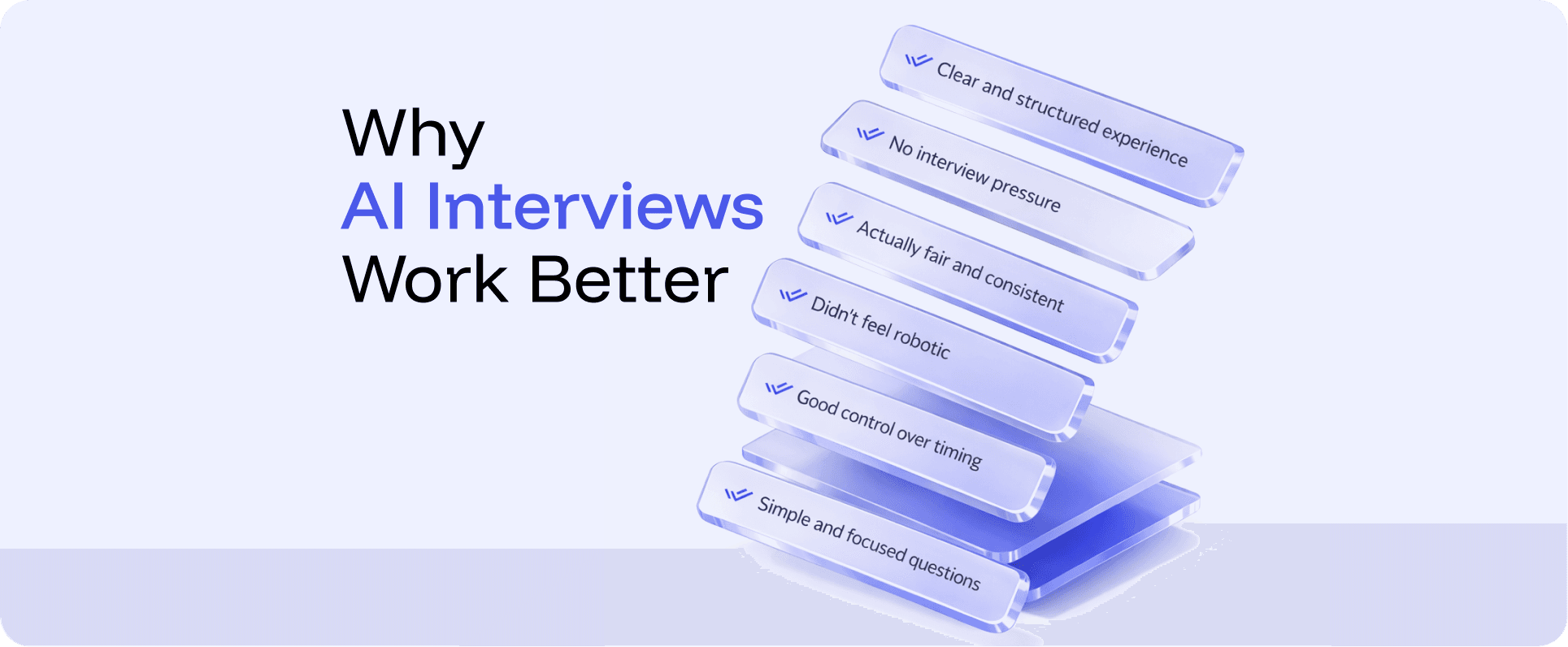
The hiring world is split: some swear AI interviews are the future, others say they're dehumanizing. We've been on both sides. Here's what we actually learned.
The elephant in the room
Let's start with what everyone's thinking but few say out loud:
"AI can't interview people. It's a bot. It doesn't understand nuance, body language, or culture fit."
We've heard this from HR directors, from founders, from recruiters with 20 years of experience. And honestly? Three years ago, we might have agreed.
But then we built one. And watched hundreds of real candidates go through it. And collected their feedback.
What we found surprised us — and it will probably surprise you too.
What candidates actually say
Here's unedited feedback from real candidates who went through AINA's AI interview:
"I went through the AI interview and want to share my feedback. I absolutely loved AINA. It's so much easier emotionally to talk to a 'non-real' person — but at the same time, there's no feeling of talking to a wall. She listens, gives comments relevant to my experience. As a candidate, I'm genuinely impressed."
That same candidate — who also has experience as a hiring manager building teams of 20+ people — added:
"As a hiring manager, I would be incredibly happy to delegate the initial interview to an AI assistant. It would save at least 40 working hours per week for our ops/HR team. Even if things don't work out between us, I'll recommend you to my HR contacts."
And then there's this, from a candidate who decided to test the system:
"I gave feedback at the start and asked the AI to respond like a real recruiter — to engage with my answers, create a sense of dialogue. The recruiter started doing it. Started joining in. Started giving positive reinforcement. And my human psychology kicked in — I enjoyed the interview (like a sweet drink) and was actually upset when it ended. I think I'm not the only one. This will hook candidates just as well as a live recruiter — maybe better. And that means better conversion."
These aren't marketing quotes we polished. This is how people actually feel after talking to a well-built AI interviewer.
But what about the data?
Our experience isn't an outlier. The research is catching up to what practitioners are seeing on the ground.
A randomized trial of 70,000 job applicants — published by a Chicago Booth economist — found that candidates interviewed by AI were 12% more likely to receive a job offer, 18% more likely to actually start the job, and 17% more likely to stay past 30 days. And when given a choice, 78% of applicants chose the AI interviewer over a human.
Why? Candidates — especially women and underrepresented groups — reported feeling less judged, less anxious, and more able to express themselves. The AI felt neutral. And that changed how people performed.
Meanwhile, industry-wide:
• 67% of candidates are comfortable with AI screening as long as a human makes the final decision
• 49% believe AI could actually help reduce bias in hiring
• 24–30% higher assessment consistency for teams using structured, AI-supported interviews
The data doesn't say "AI interviews are perfect." It says they're more consistent, faster, and — counterintuitively — often preferred by the very people we assumed would hate them.
Why the perception gap exists
So if the data is positive and candidates often prefer it, why do so many hiring professionals still resist?
Because most AI interview products are terrible.
The first generation of AI interviewing tools were exactly what critics feared: robotic question-answer machines with no context, no follow-up, no warmth. They asked generic questions, recorded video, and spit out a score. The candidate experience was cold. The evaluation was shallow.
No wonder people hated it.
Here's what changed — and why the second generation is fundamentally different:
From scripted Q&A to actual conversation
Early AI interviewers followed a fixed script. Question 1, answer, question 2, answer. No matter what the candidate said, the next question was predetermined.
Modern AI interviewers — including ours — actually listen. They follow up. They probe deeper on interesting answers. They adapt the conversation based on what the candidate says. That's not a chatbot. That's a structured interview conducted by an AI that understands context.
From generic to domain-expert
This is the breakthrough most people miss. A generalist recruiter screening for a medical role, a fintech compliance role, or a machine learning engineer is essentially guessing. They don't have the domain knowledge to formulate the right questions — let alone evaluate the answers.
One of our clients — a tech company — needed to hire a medical professional. Nobody on the team had clinical expertise. Our AI interviewer conducted a 30-minute structured assessment using medical terminology, case scenarios, and live evaluation. Hired in 7 days. The candidate is still in the role.
No human recruiter on that team could have run that interview. Not because they're bad at their job — because it wasn't their domain.
From evaluation to experience
The candidate who said the AI interview felt like "a sweet drink" — that reaction isn't accidental. When the AI acknowledges your answers, builds on what you said, and creates a genuine back-and-forth, something shifts psychologically. You stop performing for a judge and start having a conversation.
That's why our completion rates are high and our candidate feedback is positive. The experience is designed for people, not for filing systems.
Addressing the real objections
"AI can't assess soft skills"
Our AI evaluates composure, communication style, how someone structures their thinking, how they handle unexpected follow-ups, and how they react under pressure. For one hospitality client hiring front-of-house staff, the hiring manager said:
"I can see the person's emotions, how they carry themselves, how they react, how seriously they took it."
He now reviews AI interview recordings instead of scheduling 45-minute calls with every applicant. He sees more candidates, faster, with better signal.
"It removes the human element"
No. It removes the repetitive element. The human shows up where it actually matters — the final conversation, the culture-fit assessment, the offer negotiation, the relationship.
What we're removing is the part that was never really "human" to begin with. It was manual. A recruiter asking the same 8 questions for the 40th time this quarter isn't bringing human judgment to the process. They're exhausted. And exhausted people make inconsistent decisions.
"What about bias?"
Every AI interview follows the same rubric. Same questions. Same scoring criteria. Same evaluation framework. No Friday-afternoon fatigue. No unconscious preference for candidates who remind you of yourself.
Is AI perfect? No. But research from the University of Washington shows that when humans review candidates without AI, they exhibit little bias — but when given AI recommendations, they mirror whatever bias the AI has. The implication: if the AI is calibrated well, it actually anchors human reviewers toward better decisions.
Our AI is supervised and calibrated by domain experts. It doesn't operate in a black box. Every evaluation comes with specific observations — not generic scores — so the human reviewer can see exactly why the AI flagged or recommended a candidate.
"Candidates will hate it"
The data says otherwise. 78% chose AI when given the option. Response times dropped from days to under 24 hours. Completion rates are higher than traditional phone screens.
Candidates hate waiting 2 weeks for a response. They hate repeating their CV to 3 different people. They hate radio silence. A structured 30-minute AI interview that gives them a real evaluation — and treats them with respect — turns out to be something most people actually prefer.
Why we made it optional
With all this evidence, why not make AI interviews mandatory for every AINA client?
Because trust is earned, not forced.
Some roles don't need it. A senior executive hire where you have 3 candidates and a personal relationship with each? Skip the AI. A warm referral from a trusted partner? Maybe you go straight to conversation.
And some teams aren't ready. That's fine. We'd rather they see the results from the rest of the workflow — the sourcing, the screening, the pipeline management — and come to AI interviews when they're curious, not when they're pressured.
What we've found: teams that start with AI interviews as optional almost always expand usage within the first month. Not because we push it. Because once you see your hiring manager get hours back — and better candidates in the pipeline — the debate becomes academic.
The bottom line
The conversation about AI interviews is stuck in 2022. The technology has moved. The candidate experience has moved. The data has moved.
The companies that fear AI interviews the most are usually the ones burning the most hours on screening that isn't working. And the candidates who are supposedly "against" AI interviewers? Most of them prefer it when it's done right.
We built AINA's AI interviewer for the people on both sides of the table — the hiring team that's drowning in repetitive screens, and the candidate who deserves a real evaluation instead of a checkbox exercise.
AI interviews aren't the future of hiring. They're the fix for the part of hiring that was already broken.
Want to see how it works? Try AINA
#AIInterview #HiringEthics #AIHiring